

Explore Smart Read in Your AI Translator →
Reading in another language should feel like reading—not like completing a translation exercise one word at a time.
When you stop at every unfamiliar expression, the main idea quickly disappears behind a series of dictionary searches. Translating the entire page can be just as limiting: it may help you finish the article, but it also removes the original language you wanted to practice.
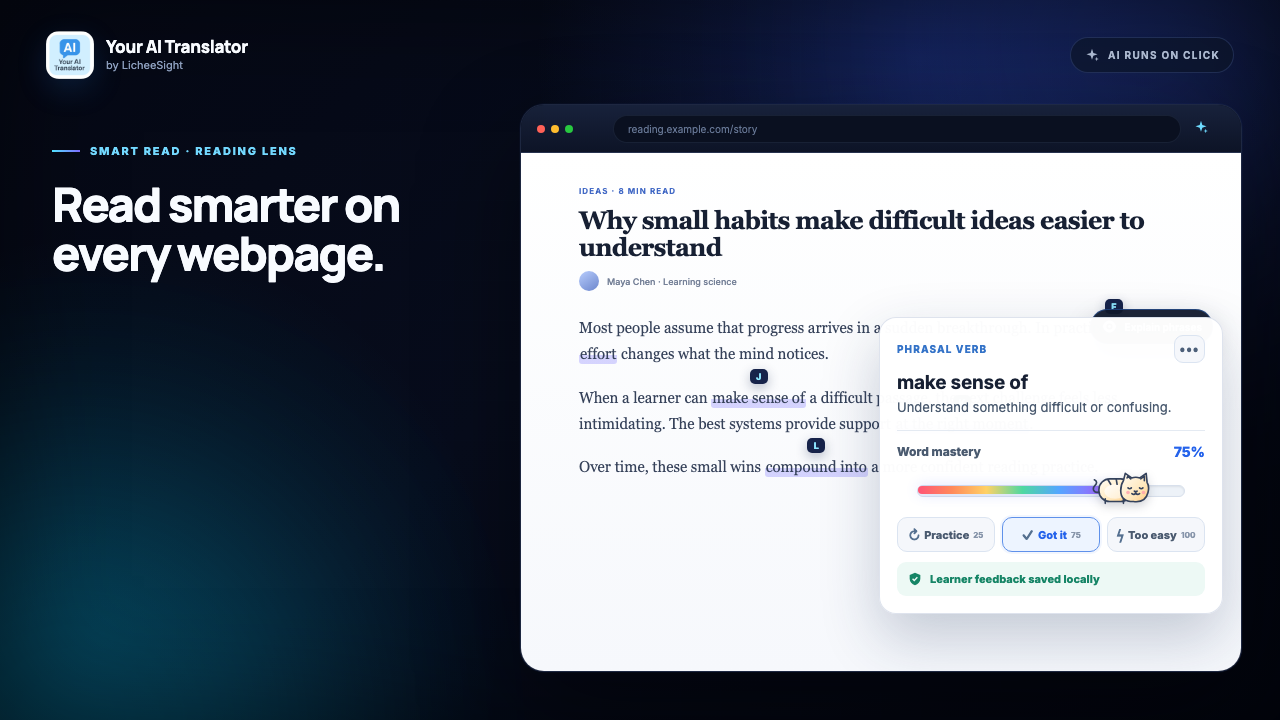
A better approach is to keep reading in the original language and ask for help only when something important blocks your understanding. Smart Read in Your AI Translator is designed for exactly that balance. After you start it on the content you want help with, it highlights useful phrases, explains them in context, and leaves the original page in front of you.
1. Why Translating Every Word Makes Reading Harder
You do not need to understand every word to follow an article, story, or blog post. Often, the surrounding sentence gives you enough information to keep going.
The problem begins when an unfamiliar phrase carries an important part of the meaning. You pause, search each word, compare definitions, and then try to find your place again. The reading session becomes a lookup session.
Smart Read takes a more selective approach. Instead of translating everything, it helps you notice the expressions that are most useful for understanding the passage. You get support where it matters while the rest of the text stays untouched.
2. Learn From the Web You Already Read
Many language-learning tools begin with their own library of lessons and reading materials. Smart Read lets your interests guide what you read instead.
Smart Read works directly on readable webpages, so your interests can guide your practice. You can learn from an international news story, a travel blog, a short story, study material, or an article related to your work. There is no need to copy the text, upload a file, or import the page into a separate reading app.
The webpage remains the reading experience; Smart Read simply adds help when you need it.
3. Focus on the Phrases That Actually Matter
Looking up isolated words can miss the way people naturally use language. A familiar word may take on a different meaning when it appears inside a phrase, while several simple words can form an expression that is difficult to understand as a whole.
Smart Read looks for useful words and phrases in the passage for you. Instead of investigating every possible unknown word, you can focus on a smaller set of expressions that unlock the text.
You are still doing the reading and seeing how the language works. Smart Read removes important obstacles without covering the page with explanations.
This selective approach can also reduce the cost of AI assistance. Smart Read focuses on the paragraph you choose and returns a few useful explanations instead of translating a long page that you may already mostly understand.
4. Understand Meaning in the Original Context
Imagine reading the English sentence: “After months of uncertainty, the team finally turned the corner.” A word-by-word translation may suggest that the team physically changed direction. In this context, however, “turned the corner” means that a difficult situation began to improve.
Smart Read explains a phrase using the sentence where it appears. That context helps you understand what the writer means here, rather than presenting a long list of possible definitions.
You see the expression, understand its role in the passage, and continue reading while the example is still fresh.
5. Get Help Without Replacing the Original Page
Reading Lens offers help alongside the content you are already reading. When you reach a difficult part, you can open a short explanation and then return your attention to the paragraph.
The original words, sentences, and page layout remain visible. This is an important difference from full-page translation: Smart Read supports your understanding without replacing the material you chose to practice with.
If you prefer to decide exactly where to begin, you can also run Smart Read on a paragraph or readable section. Both approaches share the same goal—give you enough help to keep moving through the original text. When you need to ask broader questions about an entire section or diagram, you can also use our context-aware sidebar chat to query the page side-by-side.
6. See Hints That Match Your Level
A useful hint for a beginner may be obvious or distracting to an advanced learner.
Smart Read can tailor its suggestions to your learning language, reading level, and focus. A news reader may need help with different expressions than someone studying academic material.
Keep hints light for a smoother reading session or ask for more detail with a challenging passage.
7. Make Smart Read More Personal Over Time
Each explanation includes a Word mastery slider with a cat mascot. Move the cat to the point that best matches your understanding:
- Practice for language you still want to work on.
- Got it when the meaning now feels familiar.
- Too easy when you no longer need this kind of hint.
If a hint is not relevant, open the additional-actions menu and choose Hide this hint. Your mastery feedback stays local in your browser and helps future hints better match your level.
Over time, this creates a calmer reading experience with fewer interruptions from material you already understand.
8. Turn Everyday Browsing Into Language Practice
Open something you genuinely want to read, use Smart Read when an important phrase slows you down, and give quick feedback before continuing.
That simple routine turns everyday browsing into language practice:
- Choose a readable webpage in the language you are learning.
- Use Smart Read to understand the phrases that matter to the passage.
- Move the Word mastery cat from Practice toward Got it or Too easy, then continue reading.
Today, Smart Read focuses on helping you understand the page in front of you. In the future, a learner’s reading history could become the foundation for personalized lessons and spaced-repetition review built from the words and phrases they actually encounter.
If you want to read a foreign language without translating every word, start with content you already care about and let Smart Read provide just enough help to keep you moving.