For years, developers and power users have relied on expensive subscription services for high-quality translation. However, the rapid maturity of AI models has completely altered the economics of text translation.
When consuming large volumes of foreign documentation or research papers, you have two choices:
- Packaged Platforms: Paying for static translation subscriptions with high monthly fees and volume limits.
- Bring Your Own Key (BYOK): Using a local tool that interfaces directly with raw AI APIs via your private keys.
Here is why BYOK is the clear winner for developers.
New to API keys? Start with our beginner’s guide to free-tier AI API keys to learn where to create a key and how provider limits work.
1. The Hidden Cost of Subscriptions
Traditional translation services charge you a premium for their platform, marketing, and overhead. You often pay a flat monthly fee plus a high rate per character.
For developers who read extensive documentation, these costs scale linearly and get expensive very quickly. You are paying for the wrapper, not just the translation.
2. The Raw Cost Advantage
With a BYOK extension like Your AI Translator, you pay the raw input and output cost directly to the API providers. There are no platform markups or monthly base fees for basic translation.
Because AI API costs have plummeted, you can translate massive amounts of text for very little money. Let’s look at a concrete example calculation for translating 100,000 words (approximately 500,000 characters or 130,000 input tokens, with output assumed to be roughly the same size) using different providers.
Example Cost Comparison (100,000 Words)
| Provider / Model | Pricing Model (Per Million Tokens/Chars) | Input Cost | Output Cost | Total Cost | Est. Savings |
|---|---|---|---|---|---|
| DeepL Pro | $8.99/mo base + $25.00/M chars | $8.99 | $12.50 | $21.49 | Base Rate |
| GPT-5.4 mini | $0.75/M input tokens + $4.50/M output | $0.10 | $0.59 | $0.68 | 96.8% |
| Gemini 2.5 Flash-Lite | $0.10/M input tokens + $0.40/M output | $0.01 | $0.05 | $0.07 | 99.7% |
| Claude Haiku 4.5 | $1.00/M input tokens + $5.00/M output | $0.13 | $0.65 | $0.78 | 96.4% |
Note: Provider pricing details are estimated as of June 2026 and are subject to change. For official, up-to-date rates, visit the developer consoles: OpenAI API Pricing, Anthropic Claude Pricing, Google Gemini API Pricing, and DeepL Pro Pricing.
Important: Understanding API Pricing
- Direct Billing: Raw API usage fees are paid directly to your chosen AI provider (OpenAI, Anthropic, or Google) via your personal developer console.
- No Markups: Your AI Translator charges zero markup fees on your API usage.
- Extension Plans: While basic translation using your own key is free of LicheeSight platform markups, advanced extension features (such as Word Hint, Writing Assistant, Sidebar Chat, and context tools) may require an active LicheeSight extension plan.
3. Use Multiple Providers, Not Multiple Subscriptions
Your AI Translator lets you save multiple provider connections instead of locking your workflow to a single bundled AI service. Each connection keeps its own API key, model choice, and provider settings.
You can keep free-tier connections from providers such as Gemini, OpenRouter, and Groq ready at the same time. When one provider is temporarily unavailable or reaches a rate limit, you can switch to another provider with its own independent quota. For multiple enabled connections under the same provider, Round robin can rotate requests between those connections.
Adding more keys does not automatically increase one provider’s free allowance. Many providers apply limits to the whole account or organization. The benefit is choice and availability across legitimate provider connections, not bypassing a provider’s rules.
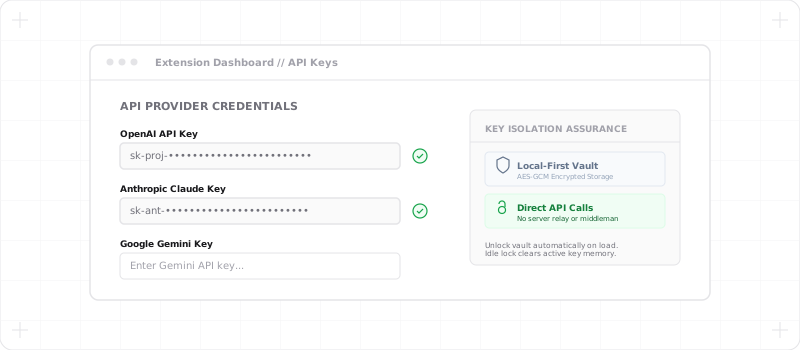
Because these keys grant access to your provider accounts, Your AI Translator stores them in a local-first encrypted vault. Read how the local API key vault works.
4. Smarter, Context-Aware Translation
Traditional machine translation engines operate on static mapping. They struggle with software development contexts, often translating technical terms literally (like “garbage collection”) and breaking the meaning.
In contrast, modern AI models understand semantic context. Because they are trained on massive codebases, they recognize code syntax, variables, and API methods. They know when not to translate a word.
The Verdict
For developers and technical readers, paying flat platform fees and inflated character costs is financially inefficient.
By bringing your own API keys, you gain granular control over your costs, access smarter translation engines, and reduce your expenses significantly (saving up to 90%+ depending on your active reading volume).